MIT Future of Work
11 November 2017
Last week, MIT held the Future of Work conference. What follows are notes of particularly interesting points made by the various speakers.
Yann LeCun
On model introspection…
The reason that deep models are not widely used yet in industry is not due to the lack of introspection. They are not used because they are not useful.
Just like any computer program, we can look at the weights learned in the model and use various statistical tools to gain introspection into the models.
On reinforcement learning…
- Reinforcement learning works well for games, things for which we are not limited by the number of trials.
- Sometimes, we have the ability to run simulators and train AI’s on these simulations and then transfer this learning to the real world.
- We cannot run the real world faster than real time.
- For the problem of solving GO, you can have a machine running on 4 TPUs running more games than all humanity ever.

On common sense…
- Cats have common sense but current AI does not yet have common sense. How do we build models that have common sense? His answer is that we need models that fill in the blanks and use predictive models of the world.
- Common sense is the ability to fill in the blanks.
- Infer state of the world from partial information.
- Infer the future from the past and the present.
- Infer past events from the present state.
- Fill in occluded images and missing segments in speech.
- Infer state of the world from partial information.
Technology drives and motivates Science and vice versa.
- Are there underlying principles behind artificial and natural intelligence?
- Are there simple principles behind learning?
- Or is the brain a large collection of “hacks” produced by evolution?
Kai-Fu Lee
- Value of country will be measured in their creativity and not in the size of their population. Population size might even be a liability.
- Blue collar jobs will be replaced after white collar jobs.
Josh Tenenbaum
- Our ability to capture the human ability to richly model the world is far away.
- How do we learn from one example?
- We study young babies and babies have common sense understanding of the objects in the world that is the basis of so much learning.
- Human expertise and basic common sense is essential.
- It is important to understand that jobs will be done by humans with AI in the loop.
- Longer term, as we start to give machines a sense of what a goal is, how will that transform how machines will work with humans .
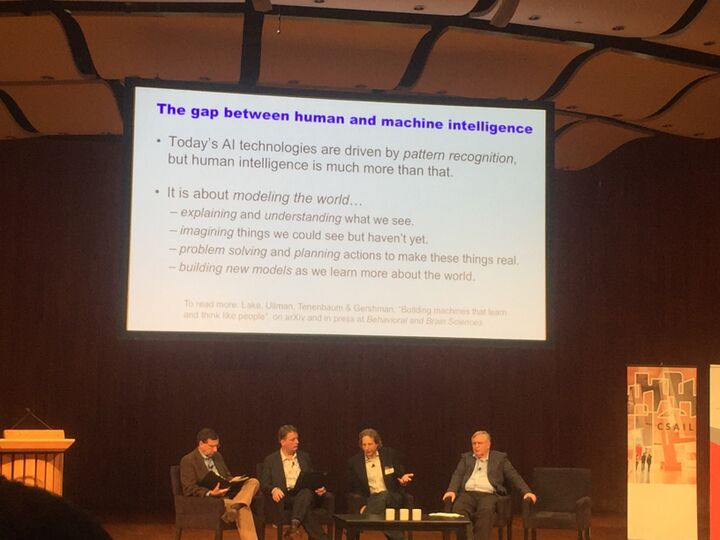
The gap between human intelligence and machine intelligence…
Today’s AI Technologies are driven by pattern recognition but human intelligence is much more than that.
It is about modeling the world.
- explaining and understanding what we see.
- imagining things that we could see but have not.
- problem solving and planning actions to make these things real.
- building new models as we learn more about the world.
- explaining and understanding what we see.
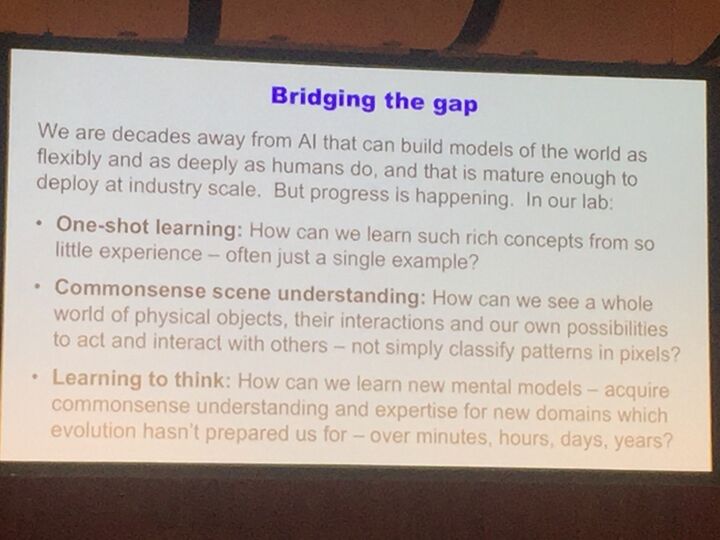
Bridging the gap…
We are decades away from AI that can build models of the world as flexibly and as deeply as humans do, and that is mature enough to deploy at industry scale.
- One-shot learning: How can we learn such rich concepts from so little experience – often just a single example?
- Commonsense scene understanding: How can we see a whole world of physical objects, their interactions and our own possibilities to act and interact with others – not simply classify patterns in pixels?
- Learning to think: How can we learn new mental models – acquire commonsense understanding and expertise for new domains which evolution hasn’t prepared us for – over minutes, hours, days, years.
- One-shot learning: How can we learn such rich concepts from so little experience – often just a single example?
AI and the future of Jobs…
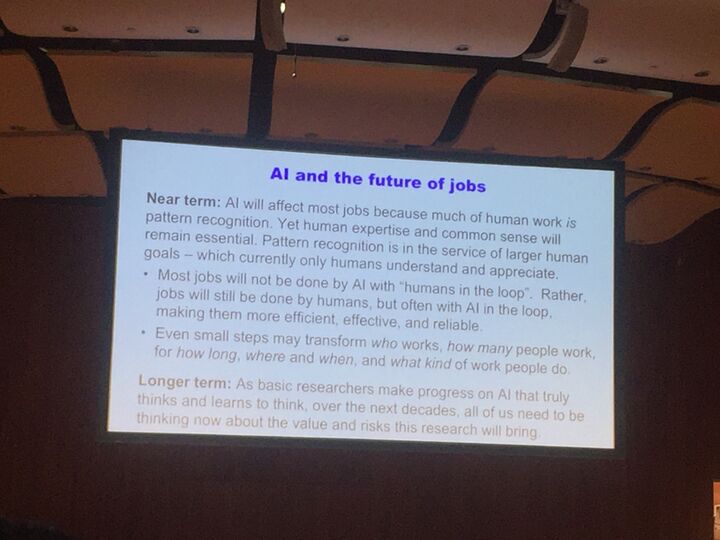
Near term: AI will affect most jobs because much of human work is pattern recognition. Yet human expertise and common sense will remain essential. Pattern recognition is in the service of larger human goals – which currently only humans understand and appreciate.
- Most jobs will not be done by AI with humans in the loop. Rather, jobs will still be done by humans, but often with AI in the loop, making them more efficient, effective, and reliable.
- Most jobs will not be done by AI with humans in the loop. Rather, jobs will still be done by humans, but often with AI in the loop, making them more efficient, effective, and reliable.
Even small steps may transform who works, how many people work, for how long, where and when, and what kind of work people do.
Longer term: As basic researchers make progress on AI that truly thinks and learns to thing, over the next decades, all of us need to be thinking now about the value and risks this research will bring.
Patrick Winston
- The word machine learning is confusing, it really is just finding statistical patterns in data so I always substitute statistics for the word machine learning.
- I think things haven’t changed much since 1985. They were saying that expert systems would rule the world; that human experts would be replaced by expert systems. But human experts ended up still having to be there. A lot of companies when broke. If we can put people together with intelligent systems, that’s where the economic value will lie.
- We still know very little about what goes on inside our skulls. Eventually we will understand what goes on inside people’s skulls. What I really mean is that I would be surprised if we can do it in the next 20 years. But we will eventually have systems that are as smart as we are.
Eric Schmidt
- Chinese population growth peaks at 2031.
- We cannot have people work more hours. In order to grow productivity in china, they need to automate. Countries like China are leading in the mission of automating more tasks.
- Governments are reactive. They react to the current needs of the current voters, but we can see the future challenges coming. We need to get people ready for this.
- For most people work is their identity so if the work week gets shorter people need something else for their identity.